Wartime policy requiring gardens to grow vegetables
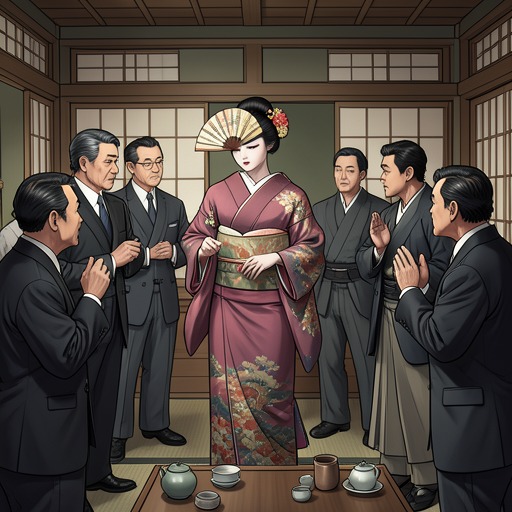
Memoirs of a GeishaThe Wartime policy requiring gardens to grow vegetables compelled households to replace decorative gardens with food crops as shortages deepened. In the novel, the rule becomes a test of wartime compliance at the Nitta okiya: its garden remains ornamental because General Tottori’s supplies make cultivation unnecessary, but that privilege draws official scrutiny. The inspection exposes how military patronage can shelter a household from ordinary demands while making its unequal good fortune conspicuous and precarious.
Wartime protection and exceptional supplies
The okiya’s ability to leave its garden untouched rests on a broader arrangement. General Tottori, Sayuri’s danna until the previous year, covers expenses including lessons, medical care, and registration, and his position as director of military procurement lets him obtain assistance unavailable through ordinary patronage. When Auntie falls ill in March 1939, he arranges for an important doctor from a military hospital to visit with medicine that cures her. The okiya also receives regular deliveries of tea, sugar, and chocolate as these goods become scarce.
That protection extends beyond the household’s own needs. During rationing, its supplies include foodstuffs and linens, and Mother passes some goods along to others in Gion, where households are bound together by mutual need. In the autumn of 1941, a maid found by the military police carrying far more ration coupons than her okiya was allowed is sent to the Nitta household for safekeeping before arrangements can be made to take her to the countryside. General Tottori has instructed the police to leave the household alone. The garden policy therefore appears within a network of privileged access: food supplies let the okiya avoid converting its garden, while military influence keeps scrutiny at bay for a time.
Inspection of the courtyard
The arrangement is tested in December 1942, a few weeks before New Year’s Day. A military policeman arrives at the okiya while Sayuri is eating her first meal after helping clean for the holiday. Rather than behaving like a deferential visitor, he removes his boots in the entrance and proceeds as though he will enter whether invited or not. He asks to see the vegetable garden.
By then, nearly everyone in Kyoto—and likely across Japan—has turned decorative gardens over to vegetables. The Nitta okiya is an exception because Tottori supplies enough food that it does not need to dig up its courtyard. Its garden still contains hair moss, spearflowers, and a small maple. In winter, Sayuri hopes the bare, frozen spots will pass as ground planted with squash and sweet potatoes. She leads the policeman outside and watches as he kneels to touch the soil, apparently checking whether it has been dug for cultivation.
Trying to deflect the inspection, Sayuri remarks on the snow, asking whether its dusting resembles foam on the ocean. The policeman does not take up the image. He stands and asks what vegetables the household has planted. Sayuri admits they have planted none and adds that the ground is now too hard and cold. The evasion fails: the policeman cites a complaint from the neighborhood association and reads a list of alleged violations, including hoarding cotton, withholding metal and rubber needed for the war effort, and misusing ration tickets. The okiya has committed these acts, as have other Gion households; what makes it a target is also its exceptional luck and its ability to remain comparatively well supplied.
Unequal enforcement and exposure
The policy’s force in this episode lies not only in its demand for cultivation but in the way an ordinary national requirement becomes an instrument of inspection. The policeman’s attention moves from the unplanted courtyard to a broader inventory of wartime offenses. A garden that might seem private becomes visible evidence of whether a household is meeting collective demands, while the accusation of other violations places the okiya’s larger system of privilege under scrutiny.
Mother returns during the confrontation and treats the policeman with unusual politeness. She takes him to the reception room and serves tea the household has obtained improperly; their conversation continues behind a closed door. The narrative does not disclose their full exchange here, but the shift from a public examination of the courtyard to a private discussion marks the limit of what the policy encounter reveals. The okiya’s protection has not made it compliant; it has allowed it to defer the sacrifices imposed on others.
Consequences and significance
The garden inspection foreshadows a more decisive loss of security. In the winter of 1942, the okiya’s former ability to rely on Tottori no longer insulates it from official pressure. Later, when the government announces the closure of the geisha districts and orders geisha to report to the registry office, Sayuri must seek help from the General, who has already ceased to be her danna. The novel places these changes within an accumulating narrowing of choices: wartime scarcity makes private privilege increasingly exposed, and the closure order threatens the livelihood that the garden inspection had helped put at risk.
The policy also casts the household’s history of debt and patronage in a new light. As an apprentice, Sayuri learns that the okiya charges her for meals, lessons, medical fees, and even the cost of acquiring her. Later, Mother adopts her after the record-setting mizuage payment has repaid those debts; the adoption extinguishes the debt but transfers Sayuri’s profits to the okiya. Under General Tottori’s wartime patronage, the same household receives expenses, goods, and protection that keep its garden ornamental. The episode does not equate those arrangements, but it makes their common structure legible: access to resources determines who bears costs, who can evade a rule, and how long such an exemption lasts. The untouched courtyard is both a remnant of beauty and a visible sign of the okiya’s unequal shelter.